|
If you've never tried a trade skill before, there are a several
things that you should know.
- The standard, or "main" tradeskills are: Baking, Brewing,
Fletching, Jewelcraft, Tailoring and Smithing. All other tradeskills
are restricted to certain races (tinkering), certain classes (alchemy,
make poison, research), or are level capped (fishing). The standard
skills could, theoretically, be raised to 250 by a level 1 character,
but we don't recommend it. ;)
- Remember that training points can only be spent on trade
skills early on. Once you hit a skill of 21 in the standard trade
skills, you MUST gain skill increases through hands-on-practice.
- While your skill in the various tradeskills in EQ increase with
practice, they can cost you quite a bit of money (in supplies),
regardless of success or failure. For the more expensive skills
(such as jewelcraft), it's wise to not only stockpile some money
in advance, but also spend the training points to get to skill
20 before trying the skill.
- Low-level players: Before you even train in a trade skill, you
should check to be sure that the materials you will need to practice
your skill are available nearby.
If they are not easily available, you have to make a hard decision
-- do you want to try the skill anyway or do you want to try another
trade skill? For example, if you want to bake, and the only baking
supplies within the nearest several zones are batwings, you'll
realize you're going to be running through a lot of zones to get
some of your more basic supplies. This isn't meant to discourage
you, but to make sure you don't spend a lot of training points
before you realize the scope of the task ahead of you. (Higher
level players tend to move around a lot, so this isn't as much
of an issue for them.)
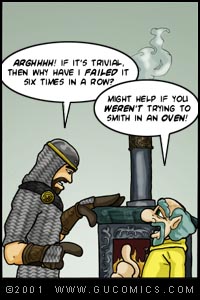
- When you see mention of a "trivial" on a chart, it means that
at that skill level, you will no longer gain skill increases from
making the item. You will, however, still continue to fail quite
a bit when making the item. Just because something is trivial
does not mean you can do it in your sleep. Eventually, as your
skill improves, your chance of failing at making the item will
decrease, but there's generally always a chance of failure.
(silk swatches and silk thread are an exception to this).
In addition, there are many spots on the recipes pages where items
are listed as <=X or >Y (or a combination of the two). Please
remember that: "<=" means less than or equal to
-- all we know about the trivial is that someone of X skill
attempted the item and it was already trivial. It may be that
the trivial is 1 point below it, or it may be 100 points below.
The only way we find such trivials is by folks reporting in their
skill levels and trivial status after they make combine attempts.
Similarly, if you see ">", it means greater than
-- someone at Y skill attempted the combine, and it was
not trivial. Again, there's no way to easily tell if the trivial
is 1 point or 100 points above that in trivial unless folks actually
report in their results.
- If you fail to make an item, regardless of your skill level,
you will receive a message "You lack the skill to fashion
these items together" (or something to that effect). ALL
this message means is that you failed to make the item (see
the mention above about trivials and the fact that things can
always fail, regardless of skill). Failure to make an item
does NOT indicate whether an item is trivial or not.
- If you're getting a failure rate that will rapidly bankrupt
you, find something that trivials closer to your current skill
to practice on. (i.e., don't try to make a silver sapphire necklace
the first time you try jewelcraft).
- For everything but fishing, sell your goods to other players
as opposed to NPC merchants where possible. If you sell to NPCs,
you rarely will be paid what the raw materials cost you, much
less the value of the item. For example, you'd get slightly over
1 gold for a piece of patchwork armor, when sold to an NPC merchant.
The going rate when selling directly to players is generally 2
gold or so, depending on supply/demand and individual whimsy.
- When a recipe calls for two or more of a single item, DO
NOT STACK the items. Have two (or more) single pieces of the
item in your forge, brew barrel, etc., not one pile of two. Regardless
of recent patch messages, many stacked items count as a single
item! If you put a stack of 20 of an item in the tradeskill container
during a combine, the container can count them as a single item,
and "eat" the extra.
- The main trade skills are not level-capped, meaning that with
enough time and raw materials, you could master the tradeskill
at level 1. Other special skills, such as fishing, make poison,
and alchemy are limited based on your level, just like your combat
and other skills.
- Grandmaster: Grandmaster (GM) in a tradeskill is generally
considered someone with a skill of 200+ in a specific tradeskill.
Of the 7 main tradeskills (baking, brewing, fletching,
jewelcraft, pottery, smithing, tailoring) you may only
have one of them above 200 (up to 250), while the rest are capped
at 200. Some folks reserve the grandmaster title only for folks
who have obtained skill 250 in their tradeskill of choice
- Specialized tradeskills are capped separately. Regardless of
whether another skill is above 200 or not, other specialized tradeskills
are as follows: Alchemy 130 before level 51, 180 at 51+; Poison
Making 200 pre-51, 250 post-51; Tinkering 250, Fishing 200
As time goes on,other information may be added to this listing.We
also recommend that you read the Frequently
Asked Questions (FAQ) section of the message boards for additional
information.
The fine print: All text on this site is copyright
by the respective authors. The game EverQuest is a registered trademark
of Sony Computer Entertainment America, Inc. This site is not meant
to represent official EQ policy, and we are not responsible for
errors/omissions that occur due to changes in EverQuest trade skills.
|